

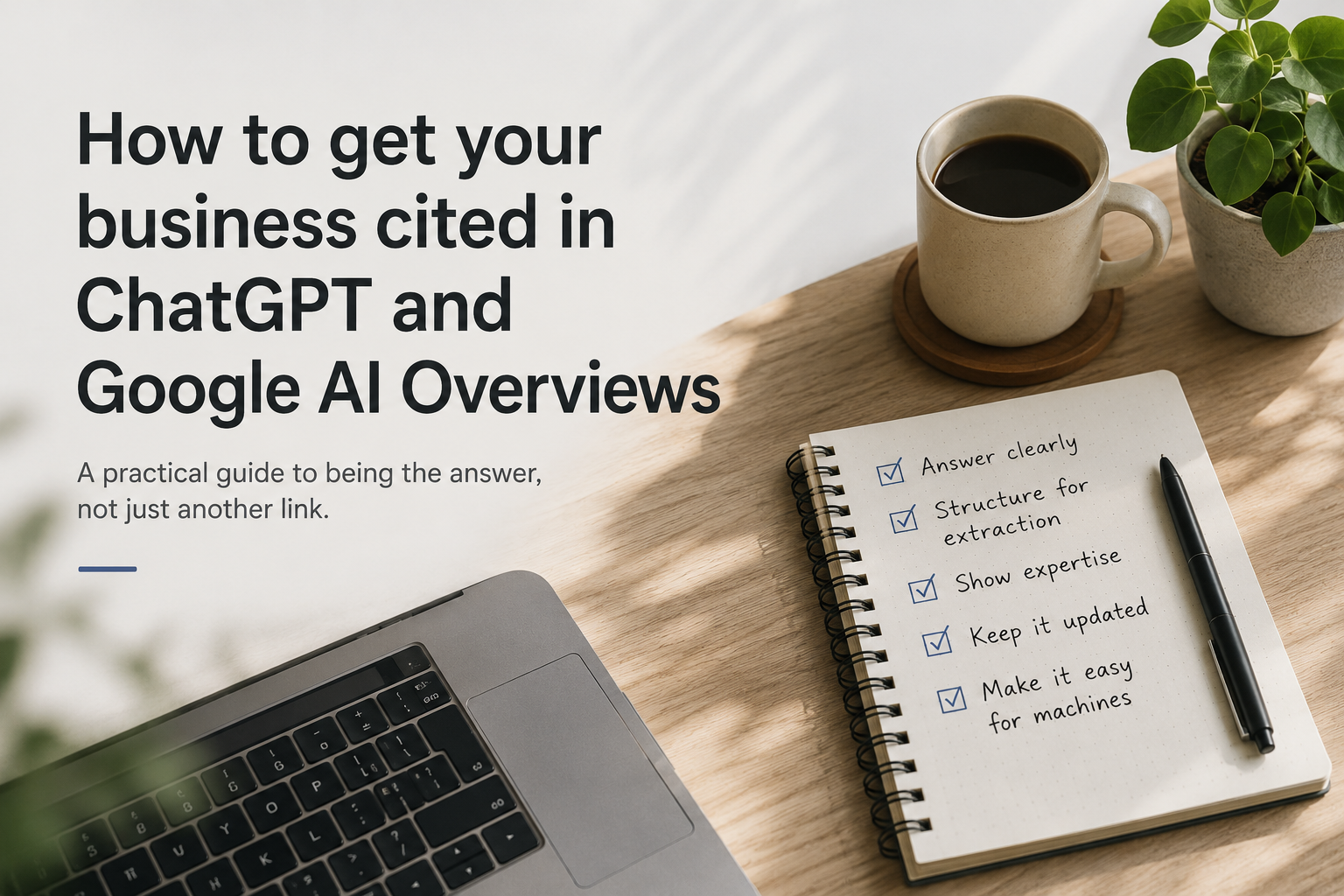
How to get your business cited in ChatGPT and Google AI Overviews (a 2026 guide for Belgian SMEs)
Written by Niels Creces, AI and automation engineer at Braiventh. Last updated: 22 August 2026.
The short answer
AI answer engines do not rank ten links and let people choose. They read a handful of sources, decide which ones are clear and trustworthy, and speak for them. To be one of those sources, your site has to answer real questions directly, be structured so a machine can lift a clean passage, and carry honest signals that you know what you are talking about.
That is the whole game, and it is a genuine shift. For twenty years the goal was to rank. Now, more and more, the goal is to be quoted.
Ranking is not the same as being cited
In classic search, you competed to appear on page one, and the user clicked through to you. In AI search, someone asks ChatGPT, Perplexity, or Google a question, and the AI writes the answer itself, citing a few sources underneath.
The uncomfortable part: you can rank well and still not be the source the AI quotes. And the hopeful part: a clearly written page can get cited even when it is not the top blue link, because these systems select on clarity and trust, not only on position.
So the work is not just "rank higher". It is "be the cleanest, most quotable answer to the questions your customers ask".
Why this matters for a Belgian SME right now
Your customers are already asking assistants the questions they used to type into Google. "Best accountant in Antwerp for freelancers." "Do I need a permit for this." "Who builds websites for small businesses in Belgium." When the answer comes back as a paragraph with two or three sources, you want to be one of them, because that paragraph is now the shortlist.
For a Belgian business there is an extra wrinkle worth getting right: language. If you serve customers in Dutch, French, and English, each version needs to answer questions properly in that language, not be an afterthought translation. AI engines answer in the language of the question, so a well-built NL page and a well-built FR page are two separate chances to be cited.
The practical checklist
None of this requires tricks. It is good, clear content, organised so both people and machines can use it.
1. Answer the question in the first two sentences. Do not bury the answer under three paragraphs of warm-up. Lead each page and each section with a direct, self-contained answer of roughly forty to sixty words. That short, complete passage is exactly what an AI lifts into its response.
2. Structure the page for extraction. Use headings that match how people actually phrase questions ("how much does a website cost", not "our pricing philosophy"). Add a short FAQ section. Use a comparison table for any "X versus Y" question. Tables and lists get quoted far more cleanly than dense prose.
3. Be specific, and show who is behind it. Vague marketing does not get cited. Concrete detail does: real numbers, clear steps, named expertise. Put an author on your content with a genuine job title, and let your service pages actually answer the obvious questions instead of gesturing at them. Research on generative engine optimisation, including the Princeton-led GEO study presented at KDD 2024, found that adding citations and statistics to content measurably increased how often AI engines surfaced it.
4. Show your work is current. AI systems favour recent content over undated content. Put a visible "last updated" date on pages that change, and actually refresh them. An answer from this year beats an identical answer with no date on it.
5. Make your business legible to machines. This is the technical layer, and it is where a properly built site pulls ahead:
- Structured data (schema) so engines understand what your pages are: your organisation, your FAQs, your articles.
- A clear, public contact page and honest, readable service information. Anything an AI would need to recommend you should be on a normal, indexable page, not hidden behind a script or a "contact us to learn more" wall.
- Clean, semantic HTML that renders without a browser fighting through four frameworks first. If the page is blank until heavy JavaScript finishes, some AI systems see blank.
- A simple
llms.txtfile that gives AI systems a plain-language overview of what you do and links to your key pages.
6. Let the AI crawlers in. If your robots.txt blocks the AI bots, those platforms literally cannot cite you. Make sure you are allowing the ones that read and cite: GPTBot and ChatGPT-User (OpenAI), PerplexityBot, ClaudeBot (Anthropic), Google-Extended (Gemini and AI Overviews), and Bingbot (Copilot). You can still block training-only crawlers if you prefer, but do not block the ones that put you in answers.
7. Be where the AI looks, not only on your own site. Answer engines cite third-party sources heavily. For a local business, the highest-value one is a complete, accurate Google Business Profile, plus consistent listings in the directories that matter for your trade. Honest presence in places your customers already discuss their problems helps too. This is earned, not gamed, and fabricating it backfires.
What not to do
A few things actively hurt, so it is worth naming them:
- Do not write separate "content for AI". The same page should serve people and machines. Google treats mass-produced AI-bait as spam, and it does not convert humans either.
- Do not stuff keywords. In AI search this measurably reduces your visibility rather than helping it.
- Do not chunk your page into tiny fragments hoping to feed the AI. Normal headings and paragraphs are what works.
- Do not block the crawlers and then wonder why you are never cited.
The Google nuance worth knowing
Google is explicit that for its own AI Overviews you do not need special files or markup. Its AI features run on the same core ranking and quality systems as normal Search, so strong, people-first content is the whole strategy there. The extra structure in this guide, the answer blocks, FAQs, tables, and llms.txt, is what helps the other engines, ChatGPT, Claude, and Perplexity, and it does not hurt Google. When in doubt, write for a person and organise for clarity, and you satisfy both camps.
The honest part
No one can guarantee you a citation, the same way no one could ever honestly guarantee a Google ranking. AI engines change, and they weigh dozens of signals. What you can do is make your business the clearest, most trustworthy, most machine-readable answer to the questions your customers ask, and then keep it current. That compounds. The businesses that start now are building an advantage that is genuinely hard to catch up on later.
Common questions
Can I pay to appear in ChatGPT or AI Overviews? No. These are organic answers drawn from content the engines find and trust. You earn a citation by being a clear, credible, well-structured source, not by buying placement.
How is this different from normal SEO? Good SEO is the foundation, and AI search builds on it. Traditional SEO gets you ranked. AI search adds a second job: being structured and trustworthy enough that the AI quotes you, sometimes even when you are not the very top link.
Do I need a whole new website for this? Usually not. Most of it is content and structure: clearer answers, an FAQ, dates, structured data, and letting the crawlers in. A rebuild only helps if the site is slow, hard for machines to read, or hides its content behind heavy scripts.
Where to start
If you want to know whether AI assistants currently mention you, the quickest check is to ask a few of them the questions your customers would ask, and see who gets cited. From there, closing the gaps above is steady, honest work that pays off for months.
See how a site is built to get found in Google and AI search, how strong local signals and structured data help you get discovered, or get in touch for a first conversation.